
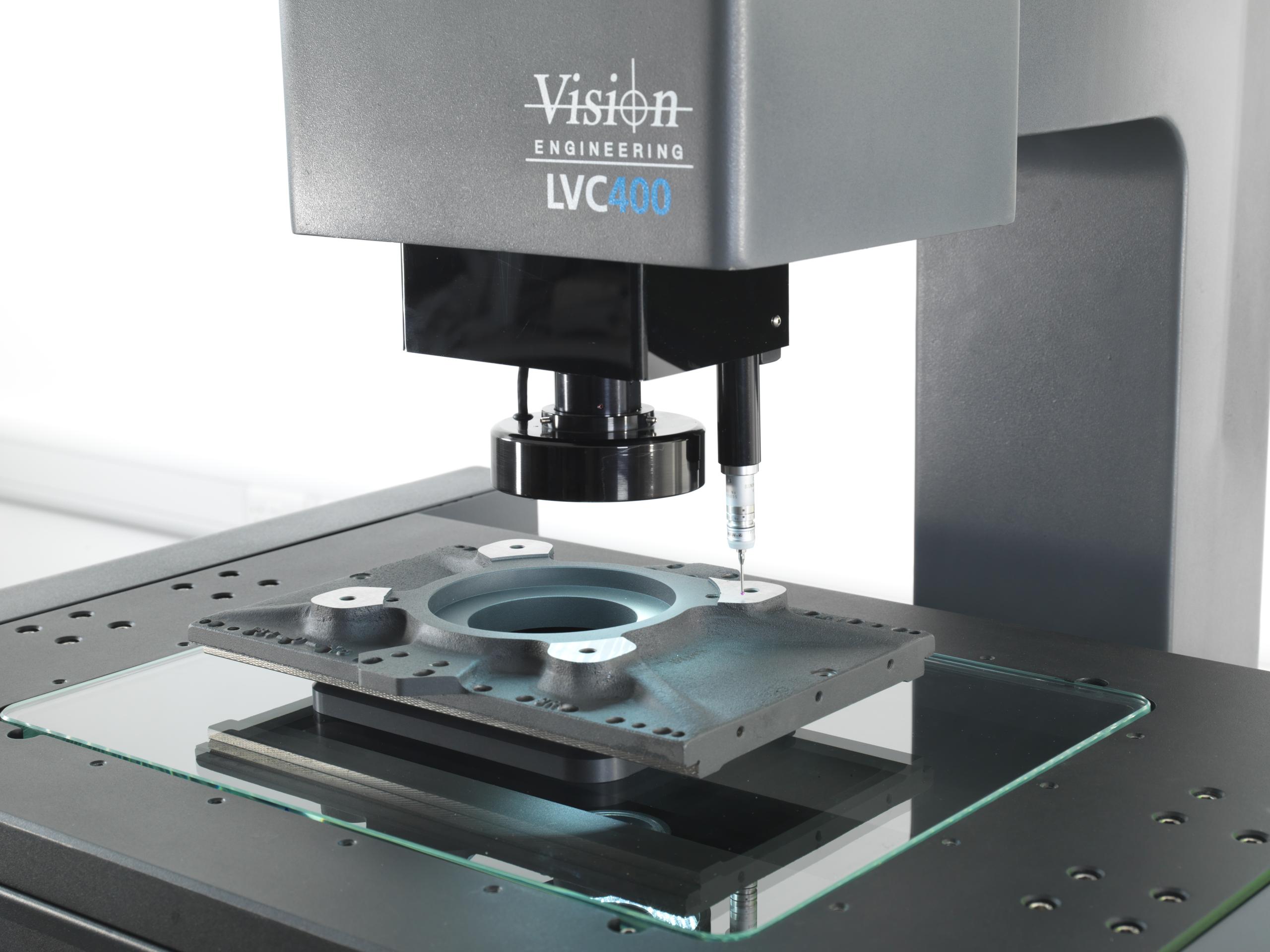
In aerospace manufacturing, inspection forms part of the controlled production process rather than a standalone activity. This reflects aerospace quality frameworks such as AS9100, where inspection supports ongoing process control and conformity, rather than acting as a final filter. By providing evidence throughout production, inspection ensures aerospace components meet design intent and quality standards, reducing rework and waste.
Components used in the aerospace industry must perform under vibration, thermal variation, and sustained mechanical stress. This leaves no tolerance for uncertainty in measurement. For this reason, aerospace manufacturing inspection cannot operate as a set of isolated checks. Measurement must remain consistent, repeatable, and traceable across every stage of production. This is a core requirement of effective aerospace metrology.
Why continuity matters more than isolated accuracy
High accuracy at a single inspection point does not guarantee overall control. Aerospace standards and ISO GPS verification rules recognize that conformance decisions depend on consistency, traceability, and known measurement uncertainty, not just nominal accuracy. This distinction plays a critical role in effective aerospace metrology and conformance decisions.
When inspection methods, data formats, or operating conditions change between stages, variation is introduced. This often leads to:
- Repeated inspections to confirm results
- Delays while discrepancies are resolved
- Reduced confidence in measurement data
Continuity in metrology reduces these risks. When inspection data remains consistent from early verification through to final validation and is supported by clear decision rules for proving conformance, aerospace manufacturers gain greater confidence in pass or fail outcomes. Deviation can then be identified earlier and corrected before it affects downstream manufacturing stages.
Surface and profile verification
Aerodynamic forms and precision aerospace components often include thin sections, complex edges, and composite materials. These features require inspection throughout production, not only at final acceptance, especially where tight tolerances and complex geometries are involved. Early-stage verification reflects the intent of first article inspection under AS9102 by confirming key characteristics against design data at an early stage.
At this stage, inspection focuses on:
- Detecting surface transitions and edge conditions
- Identifying early signs of defects, material variation, or internal defects
- Verifying profiles before downstream processes add cost
Fast, accessible inspection close to production helps prevent non-conformance from reaching later stages where correction becomes more complex, time-consuming, and costly.
Batch measurement and throughput
As production volumes increase, inspection priorities shift. Batch consistency becomes as important as individual dimensional accuracy, particularly where multiple operators, shifts, or machines are involved.
Typical requirements include:
- Repeatable measurement routines
- Reduced operator influence
- Reliable data capture for traceability
Automated or semi-automated measurement allows higher throughput while maintaining the consistency required by aerospace quality systems. This also supports structured reporting and audit readiness without adding to inspection overhead.
In-process and shop-floor measurement
Many aerospace components experience thermal and mechanical variation during manufacture. Measurement systems used on the shop floor must account for environmental influence, rather than rely on laboratory conditions.
In-process measurement enables:
- Earlier detection of deviation
- Reduced scrap and rework
- Faster feedback to machining operations
When environmental effects such as temperature and vibration are recognized and controlled, shop-floor measurement becomes a reliable part of the quality system rather than a compromise. This integration supports process control rather than postprocess correction.
From inspection to metrological control
Effective aerospace metrology is defined by how inspection supports control across the full workflow, not by a single system or specification. Standards such as AS9100 and ISO GPS place emphasis on traceability, confidence in measurement decisions, and the ability to demonstrate conformance throughout production.
By linking surface inspection, batch measurement, and in-process verification, manufacturers move from inspection activity toward metrological control. This results in consistent quality, operational confidence, and full traceability in environments where accuracy is critical.
Suitable inspection and measurement systems
Depending on production needs, aerospace manufacturers typically use a combination of optical measurement systems, CNC video measurement, and shop-floor coordinate measurement solutions.
Different stages of aerospace production place different demands on accessibility, throughput, uncertainty control, and environmental robustness. Selecting the right metrology solution at each stage gives data continuity and confidence in manufacturing decision across the production process.
Conclusion: From inspection to metrological control
Across aerospace manufacturing, controlling measurement depends on continuity rather than isolated inspection. Maintaining consistent, traceable measurement
from early verification through to in-process control allows manufacturers to manage variation, demonstrate conformity, and make informed decisions at every production stage. In an industry defined by tight tolerances and complex components, this approach remains central to effective aerospace metrology.
Vision Engineering inspection and metrology systems are used by aerospace manufacturers to maintain measurement continuity across production stages. Solutions such as EVO Cam, Lynx EVO, Swift PRO, LVC and Deltron are applied at different points in the workflow to match accessibility, throughput, and accuracy requirements, from surface verification through to in process measurement.
Based on an article written by Francesca Scarpetta, Marketing and Communications Manager for Vision Engineering Ltd Italia, where she leads marketing activity, events, and communications across key industrial sectors. With over 15 years at the company, she brings a wealth of experience in promoting advanced optical and digital inspection technologies.